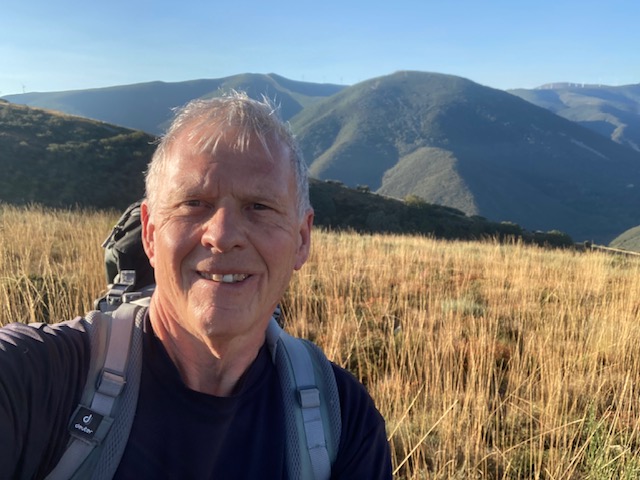
Prior to my return to the Camino Frances in 2021 to do the second half from Fromista, one of my friends who had a similar experience to me and had to return to finish warned my of the path to Molinaseca, indicating it was his most challenging day on the Camino. Naturally I discounted his warning thinking he was just having a bad day. That is until I walked it myself.
My day started at Foncebaden, which is a small town at about 1,400 meters above sea level. The first few Kilometers takes you to the Cruz de Fero which is the highest point on the Camino and 1,505 meters or 4,900 feet in elevation. It is an absolutely gorgeous walk along the mountain trails heading toward Molinaseca. One of the challenges with being at the high point is that you must descend and in this case Pelegrino’s must descent rapidly and do so on a trail that offers little or no forgiveness, is steep, rugged, rocky, erratic and goes on for about 10+ kilometers, where you emerge from this rapidly descending obstacle course just before you enter Molinaseca.
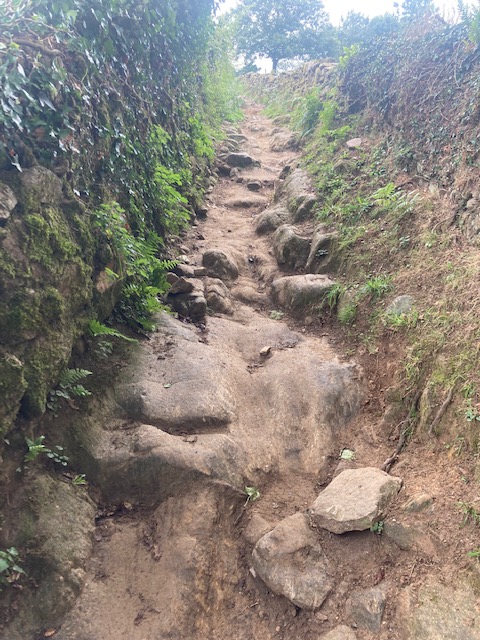
This was one of the moments where my age was a major factor in my ability to navigate this trail. Steep descents in washed out gullies carrying a backpack, was no picnic for me. I did walk for a ways with a woman from Sweden who had been living in Spain, she was in her early 30’s and did not seem phased or overly challenged by the path. I noticed her quick feet and reactions made all the difference for her to move down the trail with some degree of control and comfort. Not me, I had to carefully pick my way down the trail using my trek poles all along the way. Each step was an adventure in itself and an opportunity to fall or slip and potentially get hurt. I found that I had to keep my posture straight and I was straining my back which made me feel stiff. There were moments of vertigo during my descent. About 40% of the way down I arrived at Acebo and fortunately was able to stop for a bit to eat and gather my wits about me. I was thinking at the time that the worst of it was over, but that was not the case. Ultimately, I had to surrender and just take my time in my descent and know that I would eventually get to my destination. When I finally emerged onto level ground just a couple of hundred yards from Molinaseca, I was relieved and could finally breath easily.
Molinaseca is a lovely town with a river flowing through it and would have been a great place to stop for the day, but I had to continue on for another 8 K to Ponferrada and was so tired after I got there I was not even interested in seeing the beautiful castle. A year later when I came back to do the full Camino Frances in one trip, I did two things that helped me a lot. Instead of taking the Camino Trail, I walked the road to Molinaseca which was about 2 kilometers farther but a whole lot less challenging to my wellbeing. The second thing was to stay in Molinaseca so I could enjoy the beauty of the village.
For those who may be reading this, and you are considering doing the Camino Frances, take into consideration your age and condition. If you are young, agile, have quick feet, and are not intimidated by rough steep trails then go for it. But if you are like me and struggle with the effects of aging, consider taking the road. My basic instincts are to dive into the challenge, but my current reality has me thinking differently about doing that. I am in good shape for my age and can keep up with most anyone on the trail, but I am learning to recognize the things that give me the most trouble and deal with them in a reasonable way for the greater good of my body and my enthusiasm. There is no shame in taking the road less traveled when it is a safer and easier route.
Buen Camino,
Stephen Towles
 Camino Moments